Custom Software Development Cost in 2026 | Pricing Guide
 Zainab Saif
Blogs
Zainab Saif
Blogs
Custom software development cost depends on the product’s scope, technical complexity, integrations, architecture, security requirements, development team, and long-term support needs. There is no single reliable price for every project, a simple internal application and a large enterprise platform sit at completely different ends of the same spectrum.
This guide walks through the real cost drivers: how cost differs by software type, how MVP scope compares to enterprise scope, how team and engagement model affect price, what infrastructure and security genuinely require, what costs continue after launch, and how to prepare an estimate that holds up once development actually starts. If you’re planning a build, our custom software development services team can walk through your specific scope directly, but this guide is built to make that conversation more useful, not to replace it.
How Much Does Custom Software Development Cost?
There’s no honest way to answer this with one number. What an accurate estimate actually requires is a clear picture of:
- The business goal the software needs to serve
- Core features and user roles
- Target platforms (web, mobile, admin)
- Integrations with existing systems
- Data requirements and volume
- Architecture and expected scale
- Security and compliance needs
- Delivery timeline
- Post-launch support scope
A partner who quotes a fixed custom software development price before understanding these isn’t estimating, they’re guessing on your behalf. The rest of this guide breaks down each of these variables so you can walk into a scoping conversation already knowing what will move your number.
What Factors Affect Custom Software Development Cost?
Complexity, not the number of screens, is what actually drives custom software development pricing. Here’s how the same project category can sit at very different cost levels depending on complexity:
| Cost Factor | Lower-Complexity Project | Higher-Complexity Project | Effect on Cost |
| Product scope | Limited workflows | Multiple business workflows | More design and development effort |
| Users | One user group | Multiple roles and permissions | More access-control and UX work |
| Integrations | Few or none | CRM, ERP, payment, or third-party systems | More backend and testing work |
| Architecture | Simple application | Scalable enterprise architecture | More planning and engineering |
| Security | Standard authentication | Advanced controls and compliance | More security engineering |
| Data | Limited data | Large datasets and complex processing | More infrastructure and data work |
| Platforms | Web only | Web, mobile, and admin platforms | More development and QA effort |
Custom Software Development Cost by Application Type
Cost also varies by what you’re actually building. Broad categories carry different cost considerations, though none of them map to a single fixed price without knowing the specifics above.
Internal Business Applications
Workflow management systems, employee portals, internal dashboards, and process automation platforms. These typically have a narrower user base and fewer external integrations, which tends to keep scope more contained, though internal tools that touch sensitive HR or financial data still carry real security requirements.
SaaS Products
Multi-tenancy, subscription management, user onboarding, product analytics, and scalability all add engineering work beyond the core feature set. A SaaS product also needs to be built for users you haven’t met yet, which changes how much architecture planning happens upfront.
Customer-Facing Web Applications
UX complexity, customer accounts, payment handling, performance under real traffic, and third-party integrations all factor in. Customer-facing software also tends to carry a higher design and QA bar, since your own users, not internal staff, are the ones absorbing any rough edges.
Mobile Applications
iOS and Android requirements, the choice between native and cross-platform development, device testing across a wide hardware range, and app-store deployment and review timelines. Our dedicated guide on mobile app development cost covers this category in more depth if mobile is your primary platform.
Enterprise Software Platforms
Multiple user roles, complex cross-departmental workflows, enterprise system integrations, stronger security requirements, compliance obligations, and scalability planning. Custom enterprise software development projects tend to carry the widest range of outcomes, since “enterprise” can mean anything from a single department’s internal tool to a company-wide operating system.
AI-Enabled or Data-Intensive Applications
Data preparation, model integration, supporting infrastructure, ongoing monitoring, and recurring operational costs that continue well past initial development. Our AI and machine learning services and data engineering and analytics services pages go deeper into what this category specifically requires.
MVP vs. Enterprise Software: How Scope Changes Cost
One of the biggest cost swings comes from where a project sits between “prove the idea works” and “run the business on this.”
| Area | MVP | Enterprise Platform |
| Product goal | Validate the core solution | Support large-scale business operations |
| Features | Essential workflows only | Extensive workflows and modules |
| Users | Early users or a limited audience | Multiple departments and user groups |
| Integrations | Limited | Multiple enterprise systems |
| Architecture | Designed for focused validation | Built for scale, reliability, and long-term growth |
| Security | Appropriate for the initial use case | Advanced controls and governance |
| QA | Core user journeys | Broad functional, integration, security, and performance testing |
An MVP should not mean “poor-quality software.” It means a focused product with a deliberately controlled scope, built well within that scope, not built carelessly to save time. Our custom software development timeline guide covers how phasing an MVP before a full platform build also affects delivery speed, not just cost.
How Web, Mobile, Backend, and Integrations Affect Cost
Development effort breaks down into distinct workstreams, and each one adds its own cost:
- Product discovery — defining what actually needs to be built before anyone builds it
- UX/UI design — how the product will actually work for the people using it
- Frontend development — what users see and interact with
- Backend development — the logic, data handling, and business rules underneath
- Database design — how your data is structured and how it scales
- Mobile development — a separate workstream when iOS or Android is in scope
- API development — how your software talks to itself and to other systems
- Third-party integrations — connecting to CRMs, ERPs, payment processors, and other external tools
- QA and testing — verifying the software actually works, not just once but repeatedly
- DevOps and deployment — getting the software live and keeping it stable there
Cost increases as more of these workstreams stack, a web-only internal tool with no integrations touches far fewer of these than a customer-facing product spanning web and mobile with several external systems attached.
How Team Structure and Engagement Model Affect Cost
Who builds your software, and how that team is structured, is as much a cost driver as the software itself.
| Engagement Model | Best Suited For | Main Consideration |
| Project-based development | Clearly defined scope | Changes may require scope adjustments |
| Dedicated development team | Long-term or evolving products | Requires ongoing product ownership on your side |
| Staff augmentation | Extending an internal team | Internal management remains important |
| In-house development | Long-term internal capability | Recruitment and operational costs increase over time |
A typical custom software development team includes some combination of:
- A product or project manager
- A business analyst
- A UX/UI designer
- Frontend and backend developers
- A mobile developer, if applicable
- A QA engineer
- A DevOps engineer
- A solutions architect
The right custom software development team cost isn’t just about headcount, it’s about matching the engagement model to how long-lived and how actively evolving the product needs to be.
Architecture, Infrastructure, and Security: The Non-Optional Costs
These three areas are frequently treated as add-ons. They shouldn’t be, they should be planned according to the application’s actual risk profile and business requirements from day one.
Architecture — the choice between a monolithic application, a modular monolith, or microservices affects both build cost and how expensive future changes will be. Scalability requirements should inform this choice early, not get retrofitted later.
Infrastructure — cloud hosting, database choices, storage, monitoring, backup and recovery, and CI/CD pipelines are all part of what it takes to run software reliably, not optional extras layered on after the “real” development work.
Security — authentication, role-based access control, data encryption, audit logs, security testing, and any relevant compliance requirements. The right level of security investment depends on what data the software touches and who can act on it, not a flat checklist applied the same way to every project.
What Are the Ongoing Costs After Software Launch?
Development cost is not the complete software budget. Costs that continue after launch include:
- Application monitoring
- Cloud infrastructure
- Security updates
- Bug fixes
- Performance optimization
- Dependency updates
- Technical support
- New features
- Improvements based on real user feedback
There’s no universal, reliable percentage-of-build-cost figure for ongoing maintenance that applies evenly across projects, it depends on how actively the product continues to evolve after launch, and treating a borrowed industry percentage as your specific number is a planning mistake, not a shortcut.
Hidden Custom Software Development Costs Businesses Often Overlook

Beyond the obvious line items, these are the costs that most often get left out of an initial budget entirely:
- Requirements changes after development begins
- Complex third-party integrations discovered mid-project
- Data migration and cleanup from legacy systems
- Security and compliance reviews
- Additional user roles and permissions added after initial scoping
- Infrastructure and cloud usage that scales with real traffic
- User training and change management
- Production monitoring
- Post-launch support
- Technical debt caused by rushed early decisions
Budgeting for these upfront, even as a contingency line rather than a precise number, is usually the difference between a project that finishes on budget and one that doesn’t.
How to Prepare an Accurate Custom Software Development Estimate
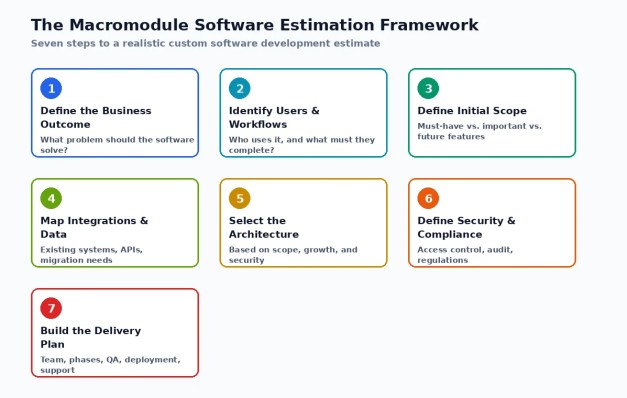
Rather than asking for a number before anyone understands your project, work through this framework first:
Step 1: Define the Business Outcome.
What business problem should the software actually solve?
Step 2: Identify Users and Workflows.
Who will use the system, and what actions do they need to complete?
Step 3: Define the Initial Product Scope.
Separate must-have features from important features from future-phase features, don’t let all three compete for the first release.
Step 4: Identify Integrations and Data Requirements.
List existing systems, APIs, data sources, and any migration requirements up front.
Step 5: Select the Appropriate Architecture.
Base this on current scope, expected growth, security needs, integration complexity, and operational needs, not on what’s trending.
Step 6: Define Security and Compliance Requirements.
Identify access controls, data sensitivity, audit requirements, and any applicable industry regulations.
Step 7: Build the Delivery Plan.
Define team structure, development phases, QA approach, deployment requirements, and post-launch support before development starts, not after.
This is the same structure we walk through with clients before quoting anything it’s, a scoping discipline, not a sales pitch.
How Can Businesses Control Custom Software Development Costs?
- Start with clear business outcomes, not a feature list
- Prioritize the highest value workflows first
- Avoid unnecessary features in the first release
- Validate requirements before development begins
- Identify integrations early, not mid-build
- Use phased delivery instead of one large release
- Plan for security and infrastructure from the beginning, not as a retrofit
- Maintain a controlled change-management process throughout
Conclusion
Custom software development cost is determined by the level of business and technical complexity, not by the number of screens or features alone. An accurate estimate requires real discovery, clear scope definition, deliberate technical planning, and an honest understanding of long-term requirements. Skipping any of these doesn’t lower your cost; it just moves the cost to later in the project, usually with less control over it.
Frequently Asked Questions
How much does custom software development cost?
It depends on scope, complexity, integrations, security requirements, and team structure, there’s no single reliable figure across every project. An accurate estimate requires understanding your specific business goals and technical requirements first.
What factors affect custom software development pricing?
Product scope, number of user roles, integrations, architecture choice, security and compliance needs, data complexity, and target platforms are the main drivers, roughly in order of impact.
Is custom software more expensive than off-the-shelf software?
Usually, yes, upfront. Off-the-shelf software trades flexibility for a lower initial cost. Custom software costs more to build but is shaped exactly around your workflow and gives you full ownership of the result.
How can businesses reduce custom software development costs?
Start with a clearly scoped MVP, validate requirements before development begins, identify integrations early, and use phased delivery instead of building everything in one release.
Does custom software require ongoing maintenance?
Yes. Monitoring, security updates, bug fixes, performance optimization, and continued improvements based on user feedback are ongoing costs separate from the initial build.
How long does custom software development take?
Timeline depends on the same factors that drive cost, scope, integrations, and compliance needs. See our full custom software development timeline guide for a detailed breakdown.
What information is needed for an accurate software development estimate?
Your business goal, target users and workflows, initial feature scope, known integrations and data sources, security and compliance requirements, and your expected delivery timeline, the same inputs covered in the estimation framework above.
Planning a Custom Software Project?
Macromodule Technologies helps businesses define product scope, evaluate technical requirements, select the right architecture, and build scalable custom software.
Request a Custom Software Development Estimate →


