Data Warehouse vs Data Lake vs Data Lakehouse: An Enterprise Decision Guide
 Zainab Saif
Blogs
Zainab Saif
Blogs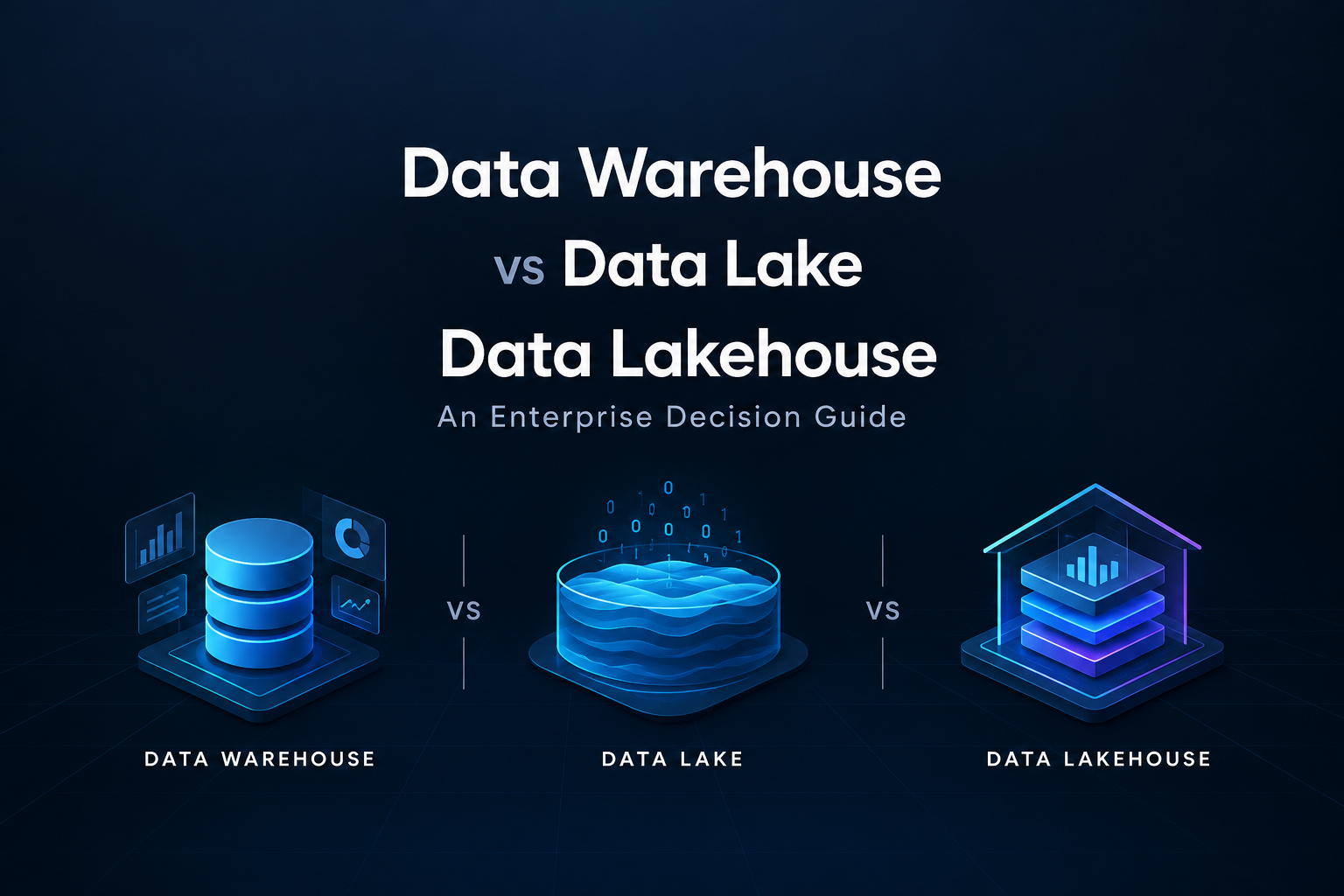
Your dashboards load slowly. Your data scientists keep exporting files to their laptops. Finance and sales still disagree about last quarter’s revenue. These are signs that your data architecture no longer matches how your business uses data. The choice between a warehouse, a lake, and a lakehouse sits behind the fix.
Searches for data warehouse vs data lake vs lakehouse often assume three versions of one product. They are not. Each pattern solves a different problem and carries different costs. This guide compares them by workload, governance, cost, skills, and risk, so you can make a decision you can defend to your board and your engineers.
The short answer
Choose a data warehouse when your priority is trusted, governed reporting on structured data.
Choose a data lake when you need to keep large volumes of raw, varied data with low storage cost and high flexibility. Choose a lakehouse when analytics and data science must share one governed copy of the data, and your team can operate the platform well.
Many enterprises combine two of these patterns. No option wins in every case. The right choice depends on your workloads, governance duties, and skills, not on which term is newer.
What each architecture does
Data warehouse
A data warehouse stores curated, structured data in a defined schema. Teams model the data as it loads, so analysts get consistent definitions for measures such as revenue or churn. Warehouses are built for SQL queries, dashboards, and audited reporting. The trade-off is less flexibility with raw, unstructured, or fast-changing data, plus modeling work up front.
Data lake
A data lake stores data in its original form, usually as files in low-cost object storage. Tables, JSON logs, images, documents, and sensor data can sit side by side. You apply structure when you read the data, not when you write it. That flexibility suits exploration and machine learning. Without cataloging and controls, though, a lake can become a swamp where nobody can find or trust anything.
Lakehouse
A lakehouse keeps data in lake-style storage and adds warehouse-style management on top. The Databricks documentation describes it as a data management system that combines the strengths of lakes and warehouses. In practice, the difference between a data lake and a lakehouse is this management layer. It often relies on open table formats, such as Apache Iceberg, which add transactions and schema evolution to files in a lake.
Those formats supply the building blocks. Your results still depend on the query engine, the catalog, and your design. A lakehouse is an architectural pattern, not a guarantee of lower cost, higher speed, or better governance.
Data warehouse vs data lake vs lakehouse at a glance
The table summarizes the main differences. Treat it as a starting point, because individual platforms vary.
| Factor | Data warehouse | Data lake | Lakehouse |
| Primary data | Structured, modeled | Raw: structured, semi-structured, unstructured | All types, with managed tables |
| Schema approach | Defined before or during load | Applied when data is read | Managed tables plus raw zones |
| Typical workloads | BI, reporting, financial analytics | Exploration, ML, long-term retention | BI and data science on shared data |
| Governance | Mature and centralized | Must be added deliberately | Depends on catalog and platform |
| Main risk | Less flexible for raw or unstructured data | Swamp, weak quality, unclear ownership | Complexity, skills, platform lock-in |
| Core skills | SQL, data modeling | Data engineering, distributed processing | Both, plus platform operations |

Figure 1. Three architectures with three different jobs.
Data types and workloads
Start with the data you have today and the data you expect in two years. If most decisions come from ERP, CRM, and billing tables, a warehouse may cover your needs well. If you also collect clickstreams, call recordings, images, device telemetry, or documents for AI, you need somewhere to hold them that a classic warehouse handles awkwardly. A lake or lakehouse fits that better.
Then list your workloads: scheduled reports, ad hoc SQL, feature engineering, model training, and data sharing with partners. Each has different needs for latency, concurrency, and structure. Let that list drive the architecture, not the reverse.
BI, analytics, AI, and machine learning
Business intelligence rewards consistency. Executives need one definition of “active customer” across every dashboard. Warehouses deliver this, and so do well-modeled lakehouse tables when a team owns the semantic layer. A raw lake rarely does on its own.
AI and machine learning change the needs. Data scientists want broad access to raw and enriched data, reproducible datasets, and tools such as Python. Lakes and lakehouses suit this because they hold varied data in open formats that many engines can read. Many warehouse platforms now support ML features too, so check each vendor’s current capabilities rather than assume. If you plan production AI, our AI development services team can help connect models to your data platform.
A lakehouse becomes attractive when BI and ML teams must work from the same governed data. It reduces copies and handoffs. It does not remove the need for modeling, testing, and clear ownership.
Governance, security, and data quality
Governance is where architecture choices often fail in practice. Four areas matter: access control, data quality, lineage, and retention.
Warehouses usually offer mature role-based access, row and column security, and audit features. A lake stores files, so you must add the catalog, permissions, and quality checks yourself. Lakehouse platforms typically provide a central catalog and fine-grained controls, but depth varies by vendor. Validate every capability against your own policies for privacy, regulation, and data residency.
Data lake governance deserves early attention. Common data lake challenges include duplicate datasets, unclear ownership, missing documentation, and uneven quality. Assign data owners, define quality rules, and catalog datasets before volume grows. Table formats add transactional guarantees that help consistency, yet they do not replace ownership or policy.
Cost, performance, and operational complexity
Be wary of blanket claims such as “lakes are cheaper” or “lakehouses cost less.” Object storage is often inexpensive per terabyte, but total cost also includes compute, data movement, engineering time, monitoring, and egress fees. Warehouse pricing can suit predictable BI workloads and grow quickly under heavy or inefficient queries. Your actual bill depends on your vendor, usage pattern, and discipline.
Performance depends on data layout, file sizes, clustering, caching, and the query engine. A poorly maintained lake table with thousands of tiny files can run slowly in any architecture.
Operational effort differs too. A managed warehouse hides much of the infrastructure. A lakehouse offers flexibility but asks your team to manage table maintenance, catalogs, and cost controls. Model total cost of ownership with your own workloads, using a pilot instead of a vendor price sheet.
Streaming and real-time requirements
“Real-time” means different things. A dashboard refreshed every few minutes is a different problem from a fraud check that needs a sub-second answer. Many warehouses and lakehouses can ingest streaming data, and some support near-real-time queries. Strict low-latency cases often need a dedicated streaming or operational system in front. State your latency target in seconds or minutes, then test it. No architecture delivers real-time results by default.
Scalability, integration, and skills
All three patterns scale on modern cloud platforms, but the effort differs. Ask how data arrives: batch ETL, change data capture, APIs, or events. Ask which tools consume it: BI, notebooks, applications, or partners. Open formats help portability and tool choice, though practical lock-in can still come from catalogs, security models, and proprietary features.
When you compare data lakehouse platforms, rate each on catalog and access control, open format support, workload isolation, monitoring, and cost controls. Skills often decide the matter. Warehouses lean on SQL and modeling. Lakes and lakehouses add data engineering, distributed processing, and platform operations. A small team running a simpler architecture well beats a large design run poorly.
How to choose a data architecture: a decision framework
Use the workflow below as a first filter, then pressure-test the result against your constraints.

Figure 2. A first-pass decision workflow. Validate the outcome with a pilot.
Choose a data warehouse when:
- Most data is structured and comes from business systems.
- Reporting accuracy and audit trails come first.
- Your team is strong in SQL and modeling.
- AI needs are limited or served elsewhere.
Choose a data lake when:
- You must retain large volumes of raw data of many types.
- Exploration and ML experiments lead the roadmap.
- A capable engineering team can add governance deliberately.
- Direct BI access is not the main goal.
Choose a lakehouse when:
- BI and ML teams need the same governed data.
- You handle both structured and unstructured data.
- You want open formats and a choice of engines.
- You can staff platform operations.
In a data lakehouse vs data warehouse decision, run two more tests. Which workloads can you not run today? Which risks, such as cost, lock-in, or compliance, would hurt most? Score each option against those answers in a workshop. Then prove the front-runner with a small pilot on real data.
Trade-offs, migration, and common mistakes
You rarely need to start over. Many enterprises keep a warehouse for finance reporting while adding a lake or lakehouse for new data and AI. Migrate by domain. Pick one high-value use case, run old and new systems in parallel, reconcile the outputs, and retire legacy pipelines only after the numbers match. If the platform feeds customer-facing software, align the data plan with your custom software development roadmap.
Avoid these common mistakes:
- Choosing by trend instead of by workload.
- Assuming a lakehouse guarantees lower cost, higher speed, or better governance.
- Skipping data ownership and cataloging.
- Ignoring skills, operating effort, and ongoing maintenance.
- Moving everything at once instead of by domain.
- Leaving security and compliance review until late.
Conclusion: start with workloads, then prove it
Begin with a workload inventory, not a platform demo. Rank your workloads, set governance and latency requirements, and shortlist one or two architectures. Run a pilot with real data, measure cost and performance, and then commit. Have a qualified data architect review the design before production, because details such as security models and table maintenance decide success. Our data engineering and analytics services cover this planning and build work.
Key takeaways
- A warehouse, a lake, and a lakehouse solve different problems and are not interchangeable labels.
- Choose by workload, governance needs, skills, and risk, not by trend.
- A lakehouse can unify BI and ML, but its benefits depend on platform, design, and operations.
- Test cost, performance, and latency in a pilot instead of trusting general claims.
- Many enterprises combine patterns, and migrating by domain lowers risk.
Frequently asked questions
What is the difference between a data lake and a lakehouse?
A data lake stores raw files with little built-in management, while a lakehouse adds a table layer on top of lake storage. That layer typically provides transactions, schema control, and a catalog, so teams can run reliable SQL analytics and machine learning on the same data. Actual capabilities depend on the platform and your design.
Can a data lakehouse replace a data warehouse?
Sometimes. A lakehouse can serve many warehouse workloads, including BI and reporting, when it has strong table management, performance tuning, and governance. Some enterprises keep a warehouse for finance or regulated reporting and use a lakehouse for broader data. Test your critical queries, concurrency needs, and security controls in a pilot before retiring anything.
Which is better for enterprise analytics: a data warehouse or a lakehouse?
Neither is better in every case. A warehouse is often simpler for governed reporting on structured data. A lakehouse fits better when analytics must also cover raw, semi-structured, or unstructured data and support data science. Choose based on workloads, governance needs, team skills, and the total cost you measure in a pilot.
How do data lakes and lakehouses handle data governance?
A plain data lake needs governance added on top, usually through a catalog, access policies, and quality checks. Lakehouse platforms often bundle a central catalog with fine-grained access control and auditing, but depth varies by vendor. In both cases, clear data ownership and documented standards matter as much as the technology.
Is a data lakehouse suitable for AI and real-time analytics?
It can be. Lakehouses suit AI well because they hold varied data in open formats that many tools can read. Real-time support varies by platform and design. Many handle near-real-time ingestion, but strict sub-second needs may require dedicated streaming or operational systems. Define your latency target first, then test it.
Talk to an Enterprise Solutions Expert
Choosing a data architecture is easier with an experienced second opinion. Macromodule Technologies helps teams design, build, and scale data platforms and the products that depend on them. Talk to an Enterprise Solutions Expert to review your workloads and plan a pilot.


