MPC vs Multisig vs Smart Contract Wallets: Security and Use-Case Comparison
The core difference is where approval happens. An MPC (multi-party computation) wallet splits signing between several parties off-chain, and the network sees one ordinary signature. A multisig (multi-signature) wallet collects several separate signatures, and the network checks each one. A smart contract wallet runs its approval rules as code on the blockchain and enhanced security, and that code can include multisig logic.
These designs are not always rivals in real world, and many teams combine them. This guide compares MPC, multisig, and smart contract wallets. It helps technical and business readers choose with confidence.
Key takeaways
- MPC protects the signing process or single points of failure. Multisig and smart contract wallets enforce rules on-chain in real time.
- No architecture is safest in every case. Implementation, devices, cryptographic key, governance, and recovery matter as much as the design.
- Multisig is visible and easy to audit. MPC is flexible across networks. Smart contract wallets are the most programmable.
- Smart contract code adds flexibility and also adds bug risk.
What Is an MPC Wallet?
An MPC wallet is a wallet where several parties hold separate key shares and sign together without rebuilding the full private key. Each party computes part of the signature. A threshold, such as 2 of 3, decides how many parties must take part.
The blockchain sees a normal single-key signature. It cannot tell that several parties produced it. NIST (the US National Institute of Standards and Technology) runs a threshold cryptography project that covers this family of methods .
The main benefit is flexibility. MPC can work on networks that only support basic signatures. The main cost is complexity. The protocol, the software, and the devices holding each share all need careful engineering. Public research has found flaws in some threshold signing implementations, so teams should review the exact protocol and library they plan to use

What Is a Multisig Wallet?
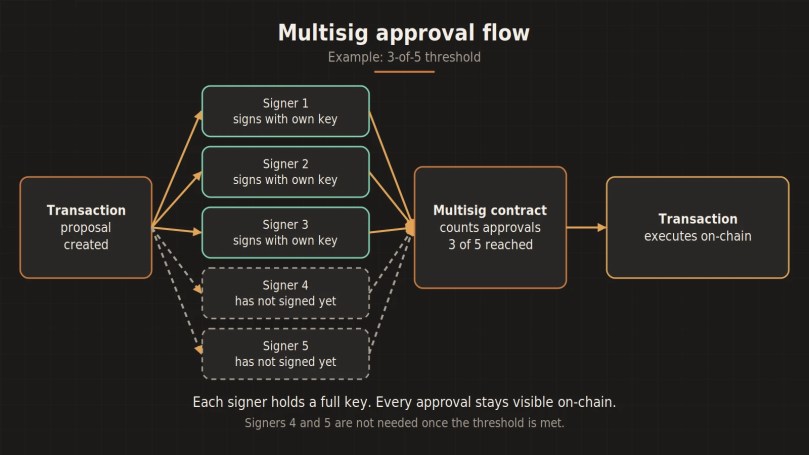
A multisig wallet needs several separate private keys to approve one transaction. A common setup is 3 of 5: five keys exist, and any three can approve. On Ethereum, multisig usually runs as a smart contract. Safe is a widely used example [3].
Each signer approves with an individual key. Anyone can inspect the signers and the threshold on-chain. That transparency helps audits and internal controls.
Multisig has trade-offs. Every approval is a separate on-chain record, which can raise fees and expose the signer set. Support also varies by network, because some chains implement multisig natively and others need contracts.
What Is a Smart Contract Wallet?
A smart contract wallet is an account controlled by contract code instead of a single key. The code sets the rules: who can approve, how much they can spend, and how recovery works. It can require several approvers, set spending limits, or allow session keys.
Ethereum’s ERC-4337 standard supports this model through account abstraction, without changes to the core protocol [4]. ERC-1271 lets other contracts check whether a smart contract wallet approved a message [5].
Many multisig wallets are smart contract wallets. The reverse is not always true, because a smart contract wallet can use one signer, a passkey, or an MPC-produced signature. The risk is the code itself. A bug in wallet logic can lock or drain funds, so audits and careful upgrade controls are essential.

MPC vs Multisig vs Smart Contract Wallets: Key Differences
| Factor | MPC wallet | Multisig wallet | Smart contract wallet |
| Where approval happens | Off-chain, between parties | Signatures checked on-chain or by network rules | Contract code on-chain |
| Key control | Separate key shares; no full key assembled | Separate full keys per signer | Depends on design; keys, passkeys, or shares |
| Recovery | Share refresh or re-sharing; depends on provider | Replace signers by following contract rules | Programmable; guardians or timelocks possible |
| Compatibility | Broad; needs only standard signatures | Varies by network | Mainly networks with smart contracts |
| Cost | Usually normal fees; vendor or infrastructure cost | Higher fees when many signatures are posted | Contract gas costs; deployment cost |
| Main risks | Protocol flaws, compromised devices, vendor dependence | Signer key loss, poor governance | Contract bugs, bad upgrades |
| Best fit | Multi-network custody, enterprise treasury | Transparent team approval | Custom rules, consumer apps |
Security Architecture and Key Management
MPC removes the single full private key. Attackers must compromise enough shares to meet the threshold. In multisig, each signer holds a complete key, and attackers must steal enough of those keys. Smart contract wallets add a third layer: the contract logic can limit what a stolen key can do.
Transaction Approval and Access Control
In MPC, the signing parties run a protocol and produce one signature. The policy engine that decides who may sign usually sits outside the blockchain. In multisig, signers approve separately and the contract counts approvals. In a smart contract wallet, the contract can enforce limits, allowlists, and delays directly.
Recovery and Failure Scenarios
Lost keys create different problems in each design. A multisig wallet can usually replace a lost signer if the threshold is still met. An MPC wallet can refresh or re-share key shares, but the process depends on the specific protocol and provider. A smart contract wallet can add guardians or time delays, though recovery rules are themselves code that needs review.
Network Compatibility, Costs, and Operational Complexity
MPC works well across networks because its output is a standard signature. Multisig and smart contract wallets depend on what each network supports. On-chain logic costs gas, and complex rules cost more. MPC shifts cost toward infrastructure and operations. Whichever design you choose, you need monitoring, key ceremonies, and tested incident procedures.
Security Risks: What Each Architecture Can and Cannot Prevent
| Threat | MPC wallet | Multisig wallet | Smart contract wallet |
| One key or share stolen | Prevented if below threshold | Prevented if below threshold | Depends on rules |
| Enough signers compromised | Not prevented | Not prevented | Limits and delays may reduce damage |
| Approving a malicious transaction | Not prevented without policy checks | Not prevented without review | Rules may block some cases |
| Code or protocol flaw | Possible in protocol or library | Possible in the contract | Possible in the wallet code |
| Lost access | Depends on backup | Depends on spare signers | Depends on recovery design |
No design stops social engineering on its own. Signers who approve a bad request will sign it in any architecture. A past multisig contract failure, the 2017 Parity wallet incident, shows how contract bugs can freeze funds [6].
Which Wallet Architecture Fits Your Use Case?
Enterprise Treasury and Team Approval
Treasury teams need clear approvals and audit trails. Multisig gives visible on-chain records. MPC suits teams that operate across several networks and want policy controls off-chain. Many teams use both for different accounts.
Consumer Applications
Consumers expect simple sign-in and easy recovery. Smart contract wallets can support passkeys, sponsored fees, and guardian recovery. MPC can also hide key management behind a familiar login.
Institutional Custody and Governance
Institutions need separation of duties, approval policies, and reporting. MPC is common here because it supports internal policy and several networks.
Applications Requiring Programmable Transaction Rules
Spending limits, allowlists, time locks, and automated payments fit smart contract wallets best. You write the rules once, and the network enforces them.
How to Choose the Right Wallet Architecture
| Your need | Suggested architecture | Main trade-off |
| Visible, auditable approvals | Multisig | Higher fees, public signer set |
| Many networks, one custody model | MPC | Protocol and vendor review |
| Custom spending rules | Smart contract wallet | Code risk |
| Easy consumer recovery | Smart contract wallet or MPC | Recovery design effort |
| Layered protection | Combined design | More complexity |
Ask these questions in order:
- Which networks must you support?
- Who approves transactions, and how many people must agree?
- How will you recover from a lost key or a departing employee?
- Do you need rules enforced by code?
- Who will audit and maintain the system?
If you plan to build a wallet inside a larger product, treat wallet design as part of your blockchain application architecture.
Frequently Asked Questions
What Are MPC Wallets?
MPC wallets split signing power across several parties. Each party holds a key share, and enough shares together create a valid signature. The full private key is never assembled in one place. The security still depends on the protocol, the software, and how the shares are stored.
Is an MPC Wallet Safe?
It can be, when the protocol, code, and operations are sound. MPC removes a single point of key theft, but it does not stop flawed implementations or approvals of bad transactions. Review audits, device controls, and recovery plans before you rely on it.
What Are the Advantages of MPC Wallets?
MPC works across many networks, avoids a single full key, and keeps approval policy off-chain. These gains come with added protocol complexity and some vendor dependence. Teams should weigh them against transparent multisig or programmable smart contract wallets.
Conclusion
The MPC vs multisig question has no universal answer. MPC protects the signing process, multisig makes approvals visible, and smart contract wallets enforce rules in code. Many strong designs combine them. Start with your networks, approval rules, and recovery needs, then match the architecture to those facts.
Ready to decide? Discuss your wallet architecture with our engineering team.


